The document titled Can Invisalign Fix Overbites Without Surgery? (Complete 2026 Guide) examines the effectiveness of Invisalign as a non-surgical treatment option for correcting overbites. It outlines the methodology, benefits, and limitations of using Invisalign in addressing this dental issue. The guide aims to provide comprehensive insights for patients considering orthodontic solutions for overbites. Ultimately, it serves as a valuable resource for those seeking to understand their options in orthodontic care. Introduction
Overbite is a common condition that affects many teenagers and adults alike. Although minor overbites might not cause much trouble, overbites of more serious degrees can bring functional challenges such as pain in the jaw joint, speech problems, uneven wear of teeth, and facial distortion. Historically, treatment for overbites, particularly deep ones, could include braces as well as surgeries under certain circumstances.
However, with the development of orthodontic techniques, many patients wonder: Can Invisalign correct an overbite without surgery?
In short, yes. But only up to a point.
In this guide, you will learn about overbites, Invisalign treatment, and how the two relate to each other.
What is an Overbite?
Overbite is a condition characterized by an overprojection of the upper anterior teeth over the lower anterior teeth in the vertical dimension. An overbite can be healthy as well as a problem. An overbite that is too deep becomes problematic in itself.
Types of Overbite
- Normal Overbite
- Upper teeth overlap lower teeth by 2–4 mm
- No treatment required
- Deep Overbite
- Excessive vertical overlap
- Lower teeth may touch the roof of the mouth
- Skeletal Overbite
- Caused by jaw structure, not just teeth alignment
- Often more complex to treat
- Dental Overbite
- Caused by tooth positioning
- Easier to correct with aligners or braces
Causes of Overbite
Identifying the root causes will help ascertain if Invisalign can correct it.
- Genetics (size and shape of the jaw)
- Thumb-sucking as a child
- Tongue-thrusting
- Bruxism (teeth grinding)
- Tooth loss and overcrowding
- Maladaptive behaviors
Problems Associated with Overbite
The failure to address an overbite may result in:
- Jaw pain and temporomandibular joint disorder (TMJ)
- Tooth erosion and tooth enamel damage
- Communication difficulties
- Chewing difficulties
- Gum disease
- Facial asymmetry
What is Invisalign?
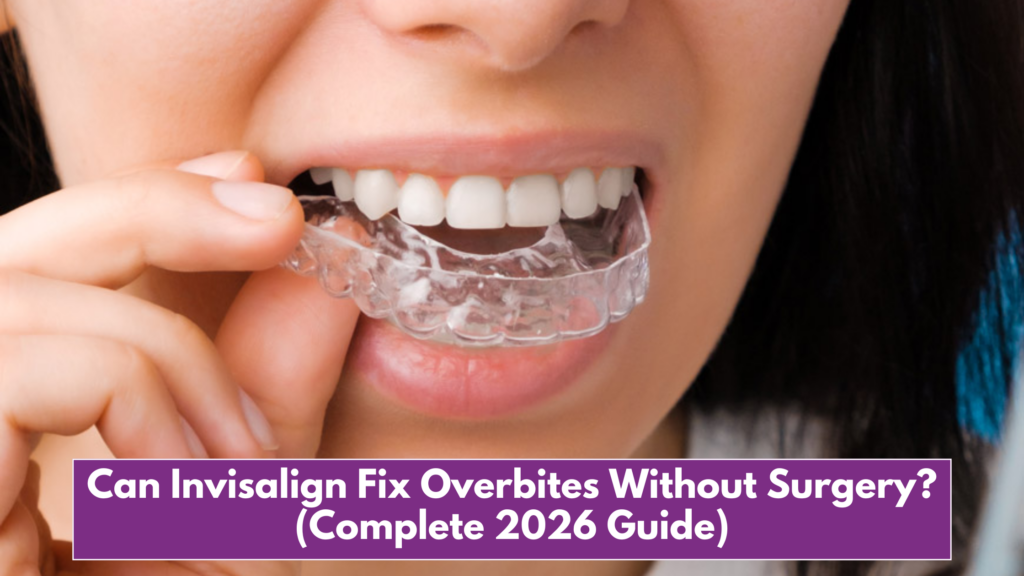
Invisalign is a recent dental care approach that utilizes transparent, removable appliances to slowly realign teeth.
Features:
Transparent and invisible
Removable when eating and cleaning teeth
Personalized for each individual
Based on 3D computer modeling
How Invisalign Works for Overbite
Apart from aligning teeth, Invisalign is capable of treating bite problems, such as overbites, by employing sophisticated biomechanics.
Techniques Employed:
Precision Attachments
- Bumps on teeth
- Aids aligners in applying appropriate forces
Elastics (Rubber Bands)
- Applied for severe overbites
- Helps realign the jaws
Tooth Movements
- Intrusion (Moving teeth up)
- Extrusion (Moving teeth down)
Rotation of teeth
- Sequential Aligners
- Trays worn for specific periods of time
Can Invisalign Fix Overbites Without Surgery?
YES – In The Following Scenarios:
Overbite of Mild Degree
- Aligners can correct this condition easily
Moderate Overbite Condition
- Effective use of Invisalign & Elastics
Dental Overbite Condition
- High Success Rate Achievable
Adults Preferring Non-Surgical Solutions
- Effective But Slower Process
NO – In These Cases:
Severe Dental Overbite
- Misalignment of jawbones
- Surgeries could be needed
Excessive Tooth Height Overlap
- Tooth adjustment is not enough
-
Problems with Growth in Youngsters
- Growth modification devices might be used
Invisalign vs Braces for Overbite
| Feature | Invisalign | Braces |
|---|---|---|
| Visibility | Nearly invisible | Visible |
| Comfort | High | Moderate |
| Removability | Yes | No |
| Effectiveness (mild/moderate) | High | High |
| Severe cases | Limited | Better |
| Oral hygiene | Easy | Difficult |
Treatment Duration
Mean Duration:
- Mild Cases: 6 to 12 months
- Moderate Cases: 12 to 18 months
- Difficult Cases: 18 to 24 months
Consistency is important—wear aligners for 20-22 hours a day.
Invisalign Treatment Procedure Steps
1. Consultation
- Your dentist will examine your teeth and decide your eligibility.
2. Digital Scan
- No more messy impressions; instead, a 3D scan is taken.
3. Treatment Plan
- You can see a preview of your new smile.
4. Aligner Manufacturing
- Custom-made aligners are made.
5. Wear Aligners
- Replace aligners every 1-2 weeks.
6. Follow Up
- Check in periodically with your dentist.
7. Retainers
- Wear after treatment as a precaution.
Benefits of Using Invisalign for an Overbite
Invisible look
- Comfortable (without braces or wires)
- Frequent dental appointments not necessary
- Predictable outcome using 3D imaging technology
- Easier oral care
Drawbacks of Using Invisalign
- Self-discipline required (should be worn at all times)
- Not suitable for serious skeletal problems
- Attachments or rubber bands may be needed
- Somewhat expensive
Overbite Correction Without Surgery for Adults?
Yes—invisalign technology has revolutionized the correction of adult overbites without surgery as long as:
- It’s purely dental, not skeletal
- The individual strictly adheres to the treatment
- It is diagnosed earlier
Realistic Expectations
Invisalign is effective but is no magic wand.
Expectations include:
- Progressive improvements
- Visible results in months
- Complete corrections in most mild/moderate conditions
However,
In severe misalignment cases, surgery may be required
Success is highly dependent on adherence to treatment guidelines
Invisalign Tips for Success
- Wear aligners 20-22 hours per day
- Keep aligners clean
- Never miss wearing aligners
- Use elastic attachments when necessary
- Follow-up visits are essential
- Practice proper oral hygiene
Tips for Successful Invisalign Treatment
- Aligners to be worn 20-22 hours daily
- Keep aligners clean
- No skipping of trays
- Use elastics if prescribed by dentist
- Attend follow-up visits
- Maintain oral hygiene
When Surgery Becomes Necessary
Indication for orthognathic surgery can be made when:
- Misalignment of the jaw is severe
- The face is impacted
- Respiration and mastication are impaired
However, despite the above criteria, Invisalign can still be used prior to or post-surgery.
Conclusion
Yes, Invisalign can treat overbites without surgery in some cases; more specifically, when it is mild to moderate in nature.
But whether Invisalign works depends on:
- Nature of overbite
- Level of severity
- Cooperation of patient
- Skills of orthodontist
If you have an overbite that is caused by improper teeth alignment, Invisalign is one of the best treatments available today.